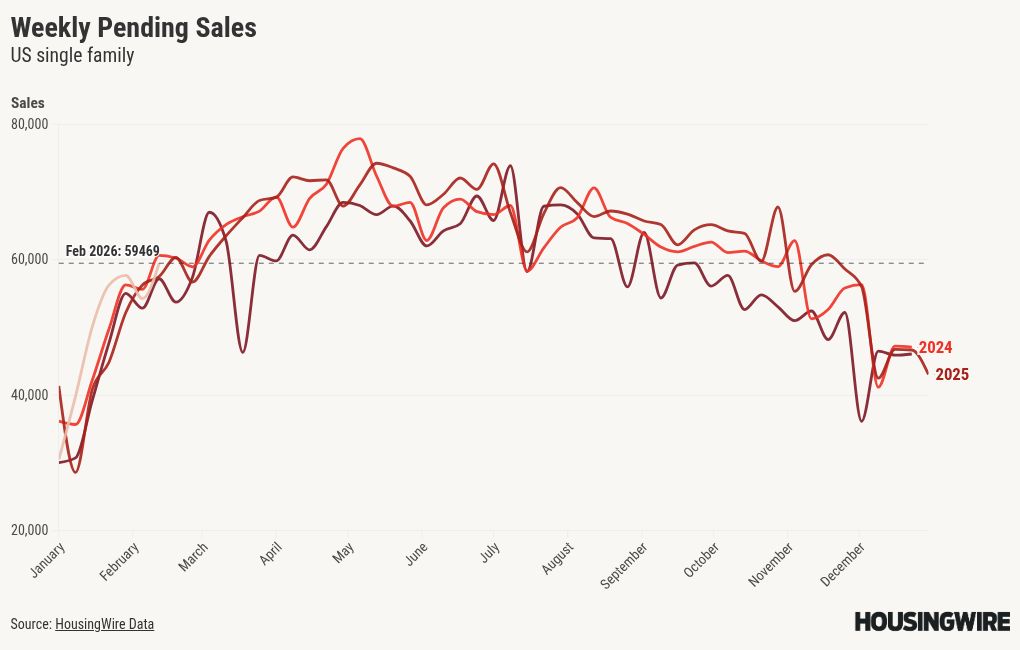
With mortgage rates near 6% and the snow effect fading away, we got a rebound in the weekly housing demand last week. For me, this is more about the snow impact fading from the data line, as we also saw a pickup in new listings.
Housing inventory picked up a smidge, and the year-over-year price cut percentage is now down almost 1% versus 2025 data last week. While I do believe some of the monthly sales data will still reflect the snowstorm, the weekly data is starting to normalize.
Weekly pending sales
Pending home sales data provide a week-to-week perspective, though results can be affected by holidays and short-term fluctuations, such as the recent winter storm that hit the country. I was expecting a small bounce last week and we were just a tad higher than what I was looking for. Soon, the winter effect will fully fade from the housing data. Our weekly pending sales data falls into the monthly sales data 30-60 days out.
For those asking about the recent existing home sales report that missed sales estimates, this episode of the HousingWire Daily podcast goes into the reasons why, and it actually wasn’t about the weather as much as it was the holiday impact.
Weekly pending sales last week over the last two years:
- 2026: 59,469
- 2025: 60,316
Note: Before the snowstorm hit, all the forward-looking data lines were positive year over year, so I believe we are almost done with all the snow impairment. For example, our total pending home sales data, which is less volatile, has shown year-over-year growth every week this year.
Mortgage purchase application data
Purchase application data is where I believe we were hit hardest by the snowstorm. Although we haven’t seen a single week of negative year-over-year data in 2026, the week-to-week results took a hit two weeks ago, and we saw a mild decline last week. What I would like to see is about 12-14 weeks of positive week-to-week data, and before the snowstorm hit the U.S., we had the best start to the year in many years.
These applications typically lag sales data by 30 to 90 days. Here’s 2026 so far:
- 2 positive week-over-week results
- 2 negative week-to-week prints
- 1 flat week-to-week print
- 3 weeks of double-digit year-over-year growth
- 5 weeks of positive year over year growth
10-year yield and mortgage rates
In the 2026 HousingWire forecast, I anticipated the following ranges:
- Mortgage rates between 5.75% and 6.75%
- The 10-year yield fluctuating between 3.80% and 4.60%
We finally had some action with the 10-year yield last week. Even with the positive headline jobs report, the bond market wasn’t really buying the stronger headline jobs data, and we closed the week on the lows Friday around 4.05%, so not that far from the lowest levels of the forecast at 3.80%. The CPI inflation report was tame enough to help the 10-year yield fall more on Friday. At one point this last week, we were at 4.25%, so a big move in yields this last week.
Rates ended the week lower at 6.04%, according to Mortgage News Daily, and mortgage rate lock data from Polly shows a weekend rate of 6.07%.
Mortgage spreads
Mortgage spreads remain a positive story for housing in 2026, reducing mortgage-rate volatility, and are close to normal levels. Historically, mortgage spreads have ranged from 1.60% to 1.80%. Last week’s spreads closed at 1.91%. If spreads matched the 2023 peak levels, mortgage rates would be 1.20 percentage points higher, at 7.24%. With spreads returning to normal, mortgage pricing can remain lower for longer than in previous years.
Weekly housing inventory data
Housing inventory grew slightly week to week. In a few weeks, we are about to see the spring seasonal rise in inventory, which is very normal if it happens late February or early March; past March isn’t a good story for inventory growth. However, I believe we should grow within that timeframe. The growth rate of inventory has cooled significantly since rates fell, but it remains at multiyear highs to keep pricing in check. We have gone from 33% year-over-year growth to just 8.24% last week.
- Weekly inventory change: (Feb. 6-Feb. 13): Inventory rose from 687,697 to 690,547
- Same week last year: (Feb. 7-Feb. 14): Inventory rose from 632,325 to 637,984
New listings data
New listings data had a nice rebound last week. I believe this is due to the snow data fading out of the data pool, with the data still slightly negative year over year, which I also blame on the snowstorm; we were positive year over year on most reports before the snowstorm hit us. I am hoping for the new listings data to range between 80,000 and 100,000 per week during the seasonal peak periods, as it did from 2013-2019. For context, during the housing bubble crash, new listings ranged from 250,000 to 400,000 per week for several years.
Here is last week’s new listings data for the past two years:
- 2026: 54,324
- 2025: 56,558
Price-cut percentage
Typically, about one-third of homes undergo price reductions before they sell, reflecting the dynamic nature of the housing market. As mortgage rates and inventory rise together, the percentage of price cuts increases. However, rates are near multiyear lows, so after a very long time, we are now seeing negative year-over-year price-cut percentage data. This shouldn’t be surprising given that demand has picked up slightly and inventory growth has slowed. This week, we are almost 1% lower than last year at this time.
The price-cut percentage for last week:
- 2026: 32.13%
- 2025: 33%
The week ahead: Housing data, Fed speeches and inflation
We will get a series of housing reports this week, including pending home sales, which I believe will show the snow impact, as well as new home sales, housing starts and the builders’ confidence data. We will also have more Federal Reserve speeches and inflation data. It will be interesting to see whether the 10-year yield tests the lows we saw last year and whether it holds the line after the sharp decline in yields last week. We are very close to the bottom forecast in mortgage rates and the 10-year yield, so this will be interesting week with the bond market.