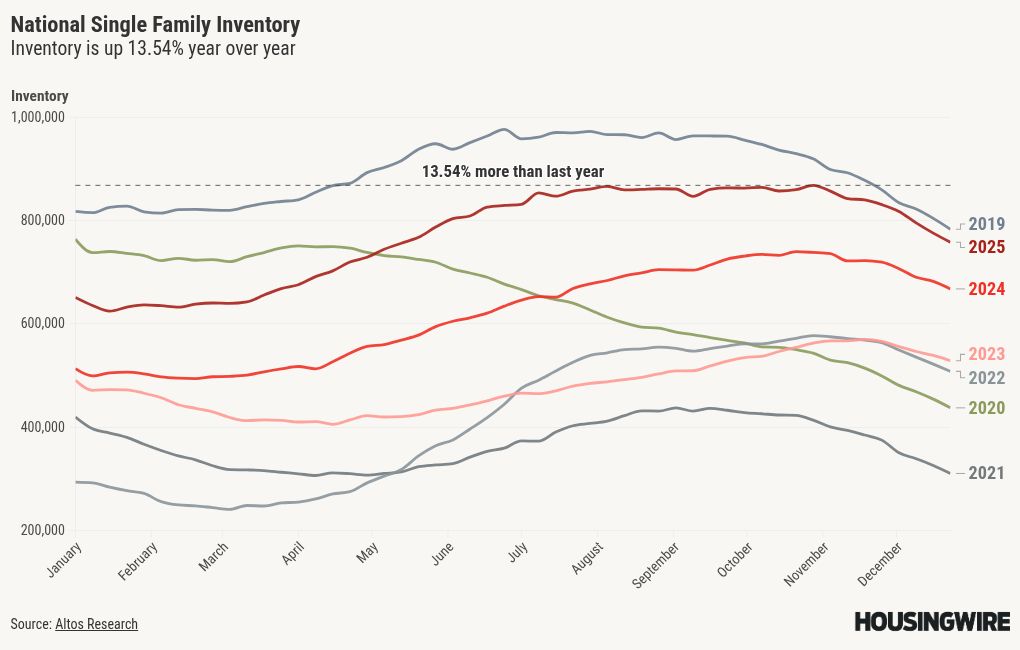
This is the final Housing Market Tracker article for 2025 and we’re going to tackle why the inventory growth rate has been cut in half this year. At one point, we had over 30% year-over-year growth, and that number is now down to 13.54%.
Why is this the last tracker of the year? I don’t put much weight into housing data the last two weeks of the year and the first week of January due to the holidays and weather. I have seen countless bad takes on the internet year after year about housing data around Christmas and New Year’s. Trust me, you will see some again this year as this is a yearly event.
The only reason I am writing the tracker this week is that we got a week of data in before the Christmas holiday week and the following week, New Year’s Day, is on a Thursday. So, this will be the last tracker of 2025 and the first one for 2026 will publish on Jan. 10. Let’s dig in.
Weekly housing inventory data
Housing inventory is now in its traditional seasonal decline for December, but the inventory growth story, which I was thrilled to see earlier in the year, has changed a lot over the last few months. The latest inventory growth percentage is now down to 13.54%, which is still positive but not as strong as the 30%+ growth we saw earlier in the year.
A few things here: we had more sellers who were going to be buyers earlier in 2025, as purchase application data consistently showed positive year-over-year growth. And for the first time in many years, our new listings data returned to the low levels we would consider normal. However, mortgage rates didn’t break below 6.64% until the second half of 2025.
New listings growth peaked late May; some sellers just called it quits, and then mortgage demand and sales picked up. In fact, the last existing home sales report came in at a 9-month high. When you’re working from the lowest bar in sales ever, once adjusting to the population, it doesn’t take much to move the needle. So that is the most straightforward answer for housing. This can also explain why the S&P Cotality Case-Shiller Home Price Indices for national, 10-city and 20-city composite have firmed up just a tad on prices month to month.
- Weekly inventory change: (Dec. 12-19): Inventory fell from 775,339 to 757,76
- Same week last year: (Dec. 13-Dec. 20): Inventory fell from 682,152 to 667,417
New listings data
New listings are also experiencing the traditional seasonal decline. I was very excited earlier this year when my forecast for weekly new listings — above 80,000 — finally happened. However, we didn’t get much growth after May, and now the seasonal decline is here. I would really love to see new listings data trend between 80,000-100,000 during any season peak period every year, which would be normal pre-COVID from 2013-2019.
To give you another perspective, during the years of the housing bubble crash, new listings were soaring between 250,000 and 400,000 per week for many years. Here’s last week’s new listings data over the past two years:
- 2025: 38,260
- 2024: 39,260
Price-cut percentage
In a typical year, about one-third of homes experience price reductions, highlighting the housing market’s dynamic nature. Many homeowners adjust their sales price as inventory levels rise and mortgage rates stay elevated. The price cut percentage growth rate cooled earlier in the year and is now also experiencing its seasonal decline.
For my 2025 price forecast, I anticipated a modest 1.77% increase in home prices, and it looks like we will be finishing the year at that level. The seasonal decline in price-cut percentage is here, as we prep for 2026. Price-cut percentages for last week in the previous two years:
- 2025: 39.1%
- 2024: 37%
Mortgage rates, spreads, and the 10-year yield
In my 2025 forecast, I anticipated the following ranges:
- Mortgage rates between 5.75% and 7.25%
- The 10-year yield fluctuating between 3.80% and 4.70%
For the year, the 10-year yield ranged from 3.87% (this was Sunday evening trading with the 3.87% print) to a high of 4.79%. Mortgage rates ranged from 6.12%-7.26%. Everything looks about right to me, considering that the bond market favored softening labor data over the inflation picking up. Since early September, we have been stuck in a range for the 10-year yield between 3.95% and 4.20%, and for mortgage rates between 6.12% and 6.36%.
Last week mortgage rates ranged between 6.29% and 6.22%, per Mortgage News Daily. Polly, data, which tracks locked loans across all credit profiles, showed rates at 6.37%.
Mortgage spreads (the hero of housing In 2025!)
For 2025, I was looking for a 0.27%-0.41% improvement in mortgage spreads, using a 2.54% average for 2024, and this week the data has been better than that at a 0.49% improvement.
In recent history, mortgage spreads have ranged between 1.60% and 1.80%. If today’s spreads were as bad as they were at the peak of 2023, mortgage rates would be roughly 1.05% higher, at 7.30%. Conversely, if the spreads returned to their normal range, mortgage rates would be 0.45% to 0.25% lower than today’s level, meaning they would be 5.80% to 6.00%.
The improvement in spreads is a huge win for the housing market as we are closer to normal and we can still get some more benefit from the spreads in 2026.
Mortgage purchase application data
Mortgage purchase application data is a forward-looking indicator, as it typically takes about 30-90 days for purchase apps to lead to home sales. In some cases, it can even be longer, as most sellers are also homebuyers, and it depends on how long it takes to sell and buy their next home.
The key to purchase apps is to have positive week-to-week and year-over-year growth data, which we have seen over the last 19 weeks. We are now at multiyear highs going into 2026. We really need 12-14 weeks of positive week-to-week data to have something of value and now we are close to that.
- 11 positive week-to-week prints
- 9 negative week-to-week prints
- 20 weeks of double-digit year-over-year growth
Total weekly pending home sales
Our total weekly pending home sales data has improved, especially compared to 2023 and 2022, and remains slightly ahead of 2024, which had harder comps. As with a lot of our data, it’s very seasonal, and the holidays are coming up. Here are the weekly pending home sales for last week over the last four years:
- 2025: 296,525
- 2024: 293,258
- 2023: 267,033
- 2022: 263,937
The week ahead: A ton of bond auctions and new home sales
It’s Christmas week and we will have a ton of bond auctions plus data on new home sales, durable goods, inflation, industrial production, weekly jobless claims and the weekly ADP data. It can be a funky bond trading week with that much Treasury supply coming and the holidays, so take this week’s market reaction with a grain of salt and make sure to Enjoy Christmas and the holidays.