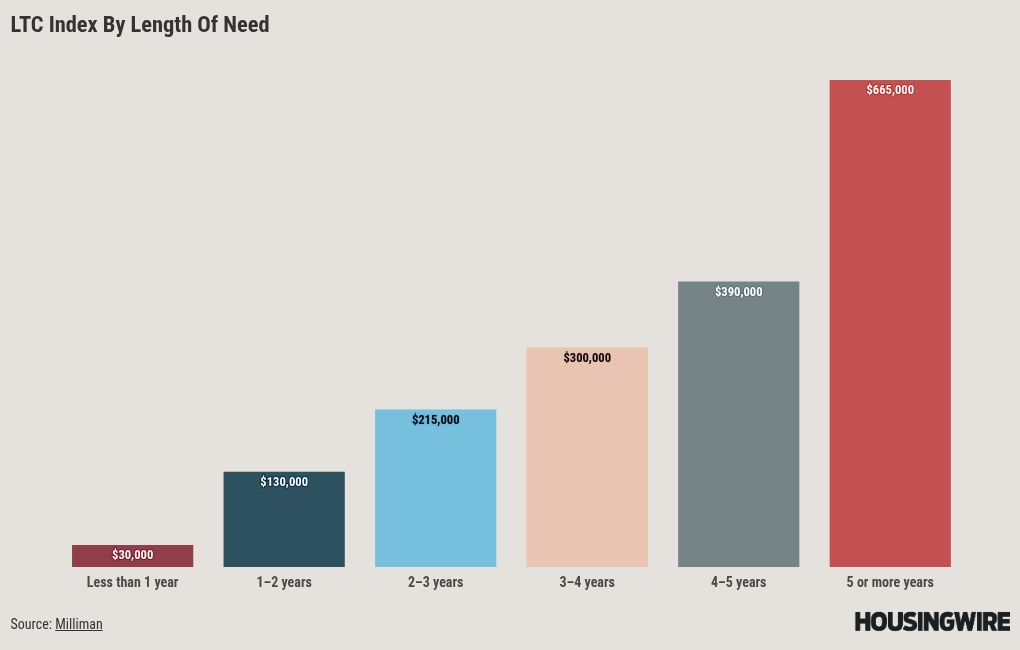
A new report from consulting firm Milliman concludes that the average 65-year-old should set aside $135,000 to cover high-intensity long-term care in the future.
But averages can mask wide variation depending on gender, location and health.
Women face significantly higher costs than men — an average of $171,000 versus $98,000 — largely because women live longer. Extended life spans increase the likelihood of requiring care for multiple years and women are less likely to have a spouse available to help for free, researchers said.
The rising cost of long-term health care and other living expenses are factors that reverse mortgage professionals should take into account when discussing home equity-based lending solutions with their clients.
Milliman found that nearly half of men and 40% of women may need no paid care at all during their lifetime. About one-quarter of men will receive less than a year of paid care, leaving only 29% with care needs lasting more than a year.
The report was the subject of a brief published this week by the Center for Retirement Research at Boston College. Milliman’s data shows that women are more likely to need long-term care, with 41% requiring more than a year and 14% needing five years or more, which can cost an average of $665,000.
Location drives costs, duration of care
The type of care — home health, assisted living or nursing home — and where a person lives can drastically affect costs.
Residents of Hawaii, California, Washington, Florida and New Hampshire tend to live longer and may need care for extended periods. Conversely, those in Mississippi, Alabama, West Virginia, Louisiana and Kentucky generally have shorter life spans and lesser care needs, according to the study.
Healthier residents also tend to need care for shorter durations.
Residents in Colorado, Montana and Hawaii have the lowest likelihood of needing paid long-term care, while those in Montana, Arizona and Oklahoma see the shortest durations of care.
Conversely, Hawaii, Connecticut and New York residents often require care for the longest periods.
Milliman’s analysis ranked states by combining the cost of services, likelihood of needing care and duration. The most expensive states are clustered along the West Coast and Northeast — with average costs about twice the national average — while the least expensive are in the South Central region.
Universal insurance could help
Milliman highlighted the need for a national long-term care insurance program.
Most seniors cannot afford future care costs — with the Federal Reserve reporting median retirement savings of $200,000 for the 65-to-74 age bracket and $130,000 for those 75 and older.
Starting retirement plan contributions earlier can dramatically reduce costs. Milliman calculated that a 35-year-old would only need to save $38,000 at a 4.35% return to cover future care — almost $100,000 less than a 65-year-old.
Washington state has launched a program that offers a base layer of long-term care coverage, with other states like Massachusetts exploring similar approaches, researchers added.
The U.S. stands alone among major nations in its lack of universal long-term and broader health care, while also spending the most in that area per capita, numerous studies show.